
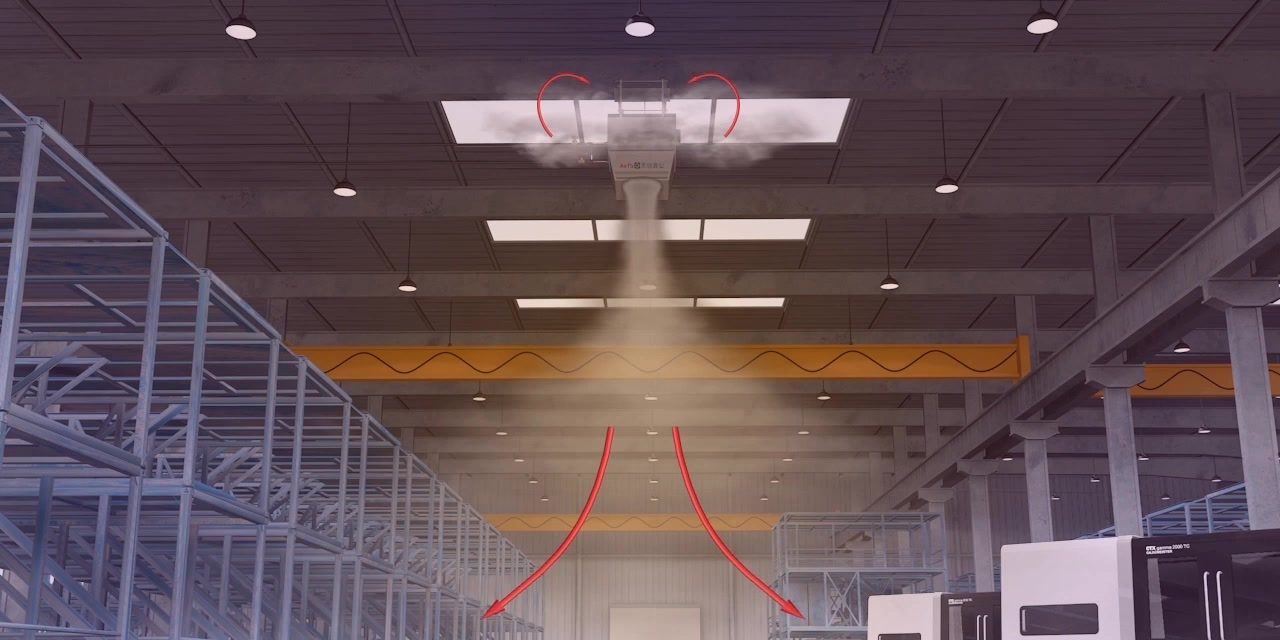
Warm air is lighter and always wants to rise, which makes driving it downwards a genuinely hard engineering problem. The answer lies in precise blade control across a range of 0° to 90°: the blades form a dense vertical jet that cuts through the height of the building and delivers heat right down to floor level.
How the hot air layer is broken up
- Effective recirculation. Quiet, energy-efficient EBM-papst fans pull the overheated air down from ceiling level and return it to where people are working; smooth 0–100 % modulation matches output to what the building actually needs.
- Vortex distribution. The swirl gives the stream stability and reach, so it drives through the cold layers all the way to the floor instead of dissipating early.
- Precise aim. Adjustable blades on Belimo actuators steer the warm stream vertically downwards and keep adjusting as conditions change.
- Maximum heat transfer. The copper-and-aluminium coil heats the space quickly while moving 25–30 % less air than conventional systems.
Heating variants
| Energy source | Series |
|---|---|
| Water (boiler house, district heating, heat pump) | OXA-D |
| Electricity (heating elements) | OXA-ED |
| Gas (integral burner, 98.9 % efficiency) | OXA-GD |
| Refrigerant (condensing unit / VRF) | OXA-530N/670N |
| Side discharge, water | OXA-SD |
Because the heat source is a module rather than a fixed part of the design, the equipment drops into whatever energy infrastructure the site already has without changing the architecture of the system.
OXA equipment selection
Send us the basics of your building: floor area, ceiling height, what the space is used for and the energy source available (water, electricity, gas or refrigerant). You will get back the recommended series, the number of units and a suggested layout.
Head office: Mycond Limited, London · Official distributor in Poland: Aklima Polska, +48 502 121 436