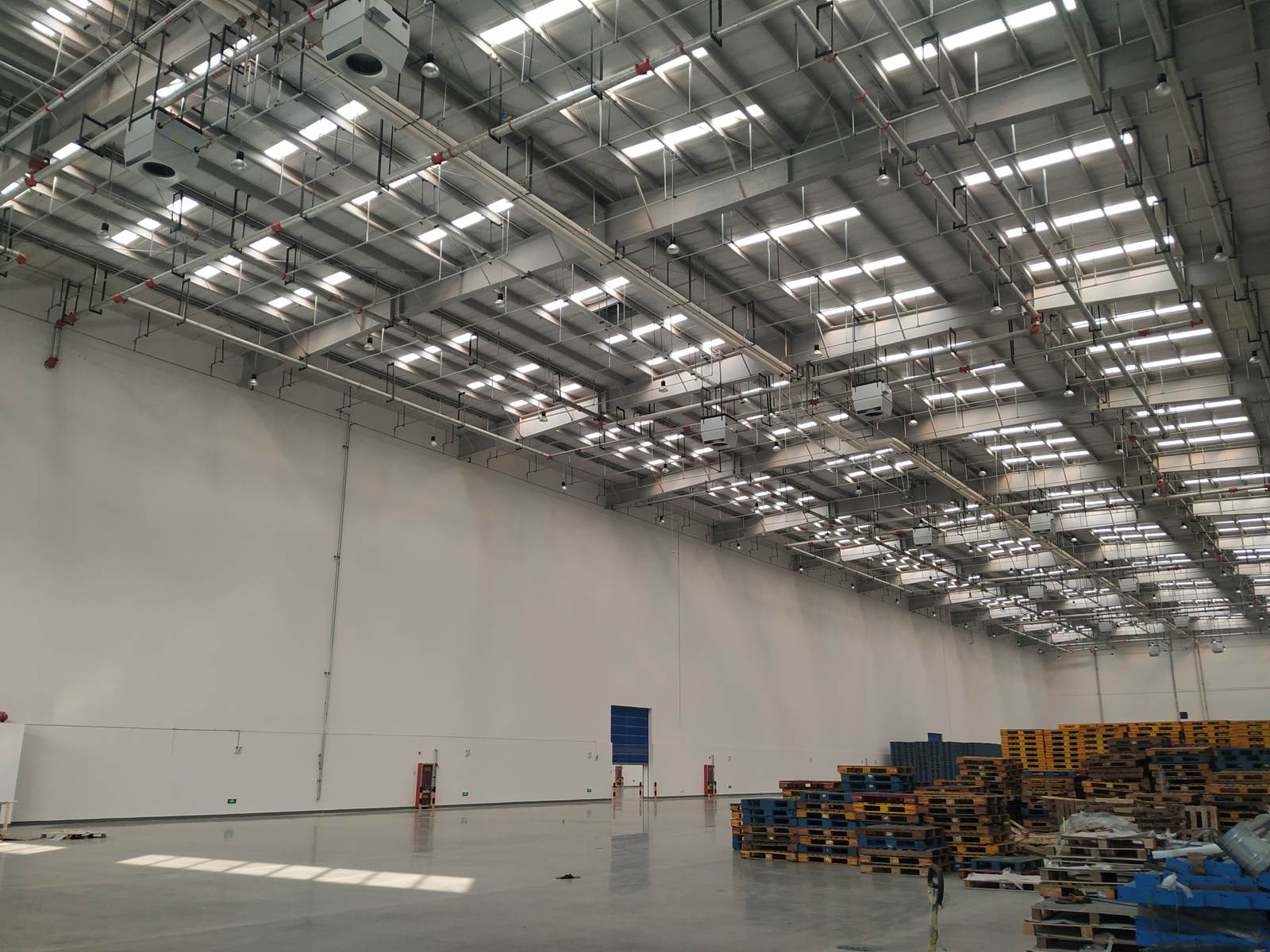
The question of how to heat a warehouse or production hall with a high roof usually comes down to four options. Here they are compared on capital cost, running cost and the quality of the climate where people actually work.
Option 1. Perimeter radiators and pipe coils
Convective heat from radiators reaches about 5 metres from the wall at best. The middle of the building stays cold while the warmed air rises unimpeded into the roof space. For buildings wider than 15–20 metres this is the most expensive way there is to end up with a cold working zone.
Option 2. Wall-mounted unit heaters
An industrial unit heater warms its immediate area quickly, but it creates hot spots in front of itself and draughts along the path of the jet. An even temperature field across a large building is simply out of reach — complaints from the staff, on the other hand, are guaranteed.
Option 3. Infrared heaters
Infrared panels heat surfaces rather than air, which is a genuine advantage at fixed workstations. The drawbacks: shadow zones behind racking and cranes, fire regulation constraints, and no effect at all on ventilation or humidity. For a warehouse with high-bay racking an infrared system almost always loses.
Option 4. Decentralised OXA units
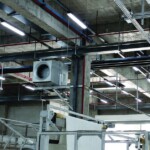
A ceiling-mounted unit with a vortex diffuser collects the overheated air from under the roof and drives it back down as a dense stream: destratification and heating happen at the same time. The result is 25–30 % less air moved, lower heating bills and an even temperature field across the whole floor — with no ductwork.
| Criterion | Radiators | Unit heaters | Infrared panels | OXA |
| Evenness across the floor | poor | patchy | shadow zones | high |
| Works at 8–30 m height | no | limited | partly | yes, 6–30 m |
| Ductwork | — | — | — | not required |
| Cooling in summer | no | no | no | yes (K/SK/FK series) |
| Fresh air | no | no | no | yes (FD/FK/AR series) |
The conclusion: where the job is economical heating of large floor areas with ceilings above 6 metres, the decentralised approach wins on both capital cost (no ductwork, no plant room) and running cost.