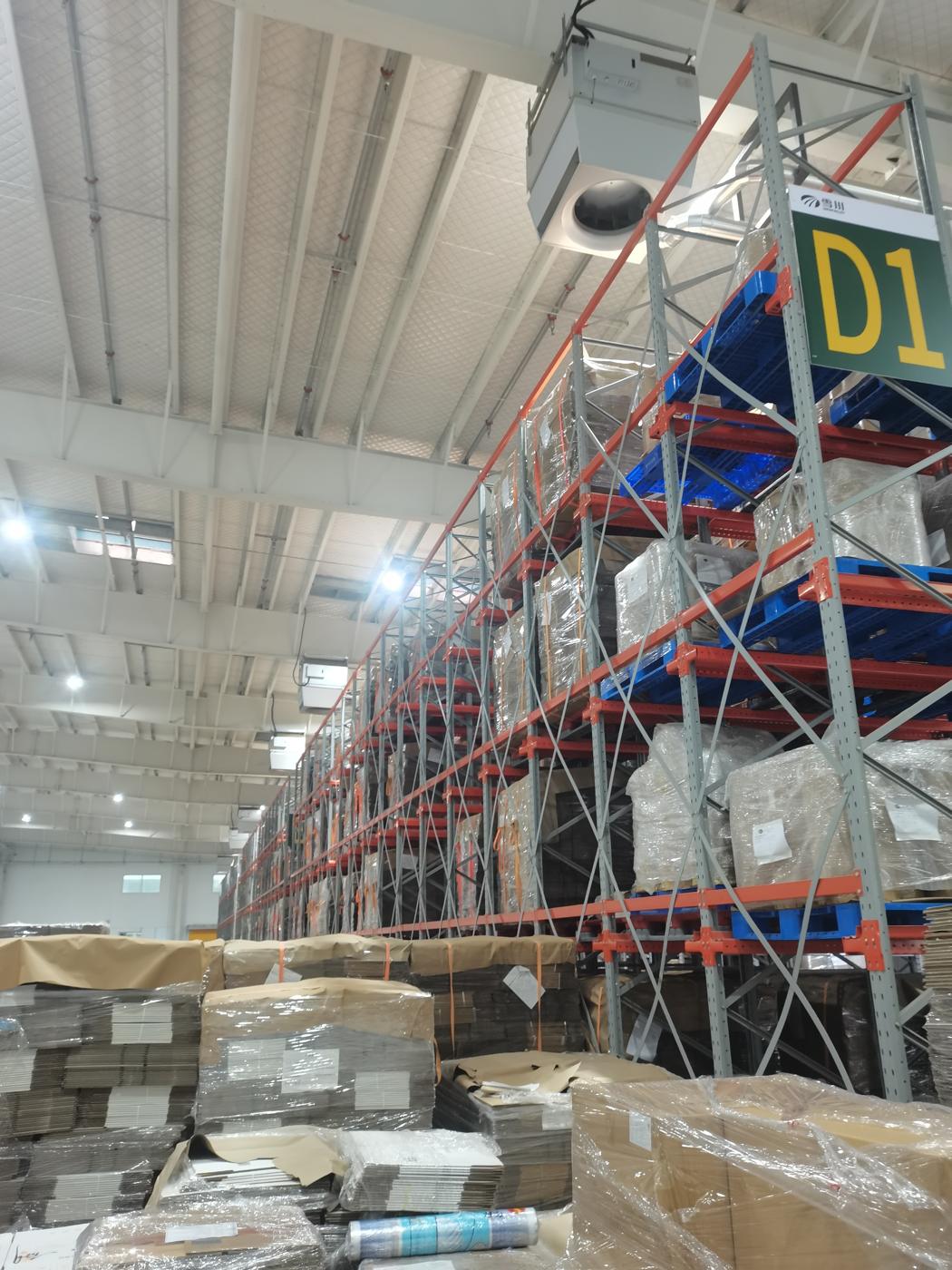
Warehouse heating costs can be cut by 30–50 % without replacing the heat source: the biggest wins come from air destratification (−25…30 %), lowering the setpoint outside working hours (−2.5…3 % per degree) and stopping the losses through the doors. Below are seven measures ranked by effect against investment, with figures for the 3,000 m² warehouse from the previous calculation (an annual demand of roughly 900 MWh of heat on a conventional scheme).
First: where the heat actually goes
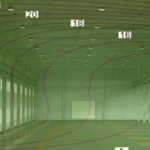
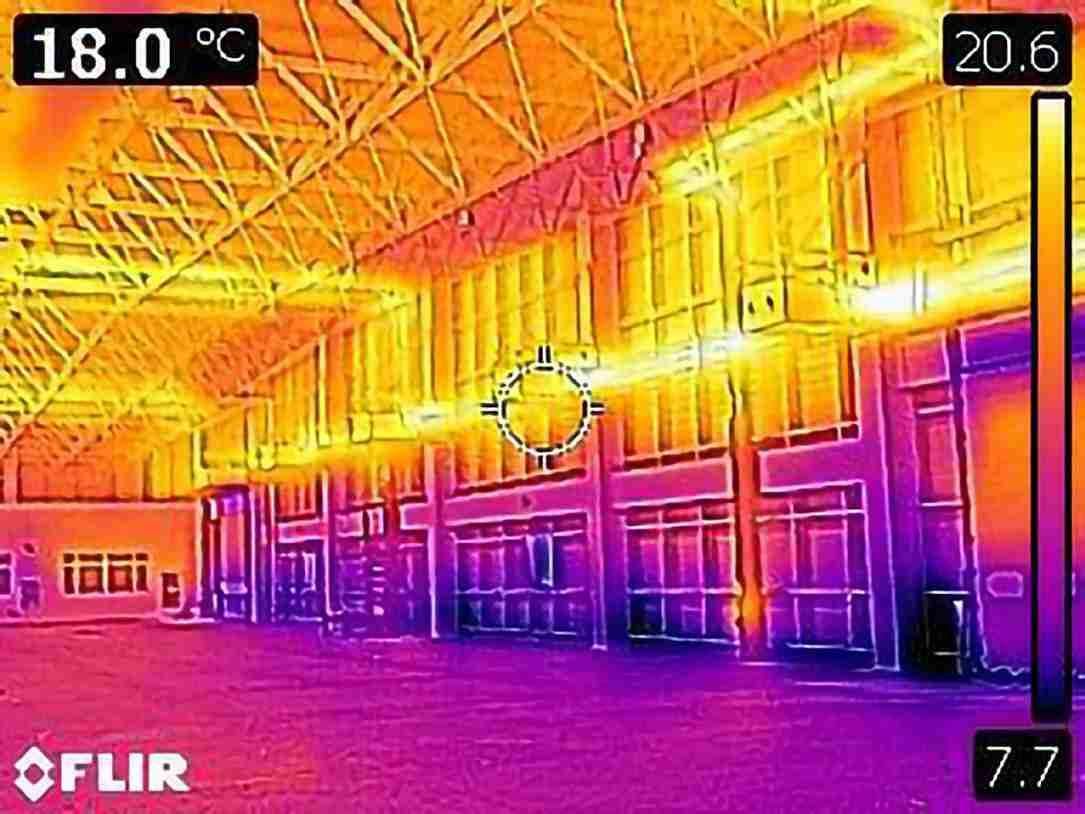
A thermal image of a typical industrial building shows the core problem with large spaces: the warmest zone is the roof trusses, the coldest is the floor where the people and the goods are. Every degree of that hot cushion under the roof increases the temperature difference with the outside air exactly where the envelope is thinnest — and the losses grow straight into the budget.
Seven measures: effect and investment
| Measure | Annual saving | Investment | Payback |
|---|---|---|---|
| 1. Destratification (vortex units instead of heating the roof) | 25–30 % | medium (replacing or adding equipment) | 1–3 seasons |
| 2. Setback outside working hours (+8 °C at night instead of +16 °C) | 10–20 % | none (controls configuration) | immediate |
| 3. Zoning: separate setpoints for storage and for workstations | 8–15 % | low | <1 season |
| 4. Door discipline: high-speed doors or air curtains | 5–15 % | medium | 1–2 seasons |
| 5. Low-temperature water from a heat pump (COP 3–3.5) | 30–50 % of the fuel component | high | 3–6 seasons |
| 6. Heat recovery on the supply air (up to 70 % of exhaust heat) | 5–20 % (where ventilation exists) | medium | 2–4 seasons |
| 7. Monitoring and schedules: sensors in the working zone, weekly programmes | 5–12 % | low | <1 season |
1. Destratification — the single biggest reserve
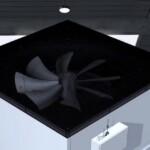
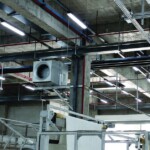
In a building 10–15 m tall, a conventional system holds the space under the roof 8–12 °C warmer than the working zone. Ceiling-mounted OXA units with vortex distribution drive that heat back down: a dense vertical jet punches through the hot cushion and opens out across the floor. The result is the same temperature where people work, on 25–30 % less energy. The mechanism is set out in detail in the description of heating mode.
2–3. Setpoints and zoning — savings that cost nothing
A warehouse does not need to be at +16 °C at three in the morning. Dropping the setpoint by 8 °C for the 12 non-working hours of the day takes 10–20 % off annual consumption — all it needs is controls with a weekly schedule. Add zoning on top: racked storage is fine at +8…+10 °C, and only the picking areas need +16…+18 °C. The wireless OXA-V system with OXA-T2 sensors handles up to 1,024 units with individual setpoints per zone.
4. Doors
A 4×4 m door standing open for 10 minutes in winter costs 300–500 kWh of heat per shift. The options, in order of budget: a procedure and monitoring of how long doors stay open → an air curtain → high-speed roller doors. On docks with constant traffic, an air curtain pays for itself in a single season.
5. A heat pump instead of gas
OXA-D units run on water at 45/40 to 70/50 °C, which makes them compatible with industrial heat pumps without peak boilers for most of the season. At a COP of 3.0–3.5, every kWh of heat costs a third of what direct electric heating costs. The energy sources are compared in the article on calculation.
A special case is a site with neither a boiler house nor gas. There the fastest scheme to build is DX: OXA-530N/670N units connected straight to a VRF system or a condensing unit — no hydraulics, no heat main, no plant room, just refrigerant lines. In winter the system runs as a heat pump (up to 75 kW of heating per unit at a COP of around 3); in summer the same outdoor unit and OXA pairing delivers up to 68 kW of cooling. Two jobs on one set of equipment, and installation measured in weeks rather than months.
6. Heat recovery
Where the process demands a constant fresh air supply, reheating it can swallow up to a quarter of the heating budget. The OXA-AR supply and extract unit recovers up to 70 % of the heat in the exhaust air, so the supply arrives already warmed.
7. Measurement
Without sensors in the working zone, the system reads the temperature next to its own casing near the ceiling — and systematically overheats the building. Remote wireless sensors plus weekly schedules plus a consumption log are worth the same 5–12 % that otherwise burns away unnoticed every month.
What that is worth in money: the 3,000 m² example
The baseline from the calculation is roughly 900 MWh of heat per season on a conventional system. Measures 1–4 together (destratification, setback, zoning and door discipline) cut demand by 35–45 %, which is 315–405 MWh every year. At the European average non-household gas price of about €0.10 per kWh that is €32,000–41,000 per season for a single warehouse of this size; on direct electric heating at around €0.20 per kWh it is €63,000–81,000. Substitute your own tariff — the arithmetic does not change.
Frequently asked questions
Where should I start on a limited budget?
With the free measures: setback mode, zoned setpoints, a door procedure. That is 15–30 % with no capital spend at all. After that, destratification, because it is the largest single reserve.
Does replacing a working system with a decentralised one pay off?
If the building is over 8 m tall and the current system heats from the perimeter, usually yes — within one to three seasons on the consumption difference alone. The precise figure comes from comparing your actual consumption against the calculated demand for a scheme with destratification.
How far can the temperature drop overnight?
For dry storage with no process requirement, down to +5…+8 °C. The limits are the dew point (condensation on goods if you reheat fast), water systems without glycol (freeze protection) and the time needed to get back to the working setpoint — OXA units with VAV control bring the occupied zone up in 30–60 minutes.