A destratifier is a device that breaks up the temperature layering in tall buildings by forcing the warm air under the roof back down into the working zone. In buildings 8–15 m tall it cuts heat consumption by 20–30 % and reduces the vertical temperature difference from 8–12 °C to 1–3 °C. Below: the three types of destratifier, field data from the US Department of Energy, and how to calculate payback.
The problem it solves
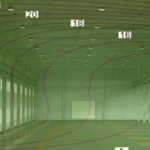
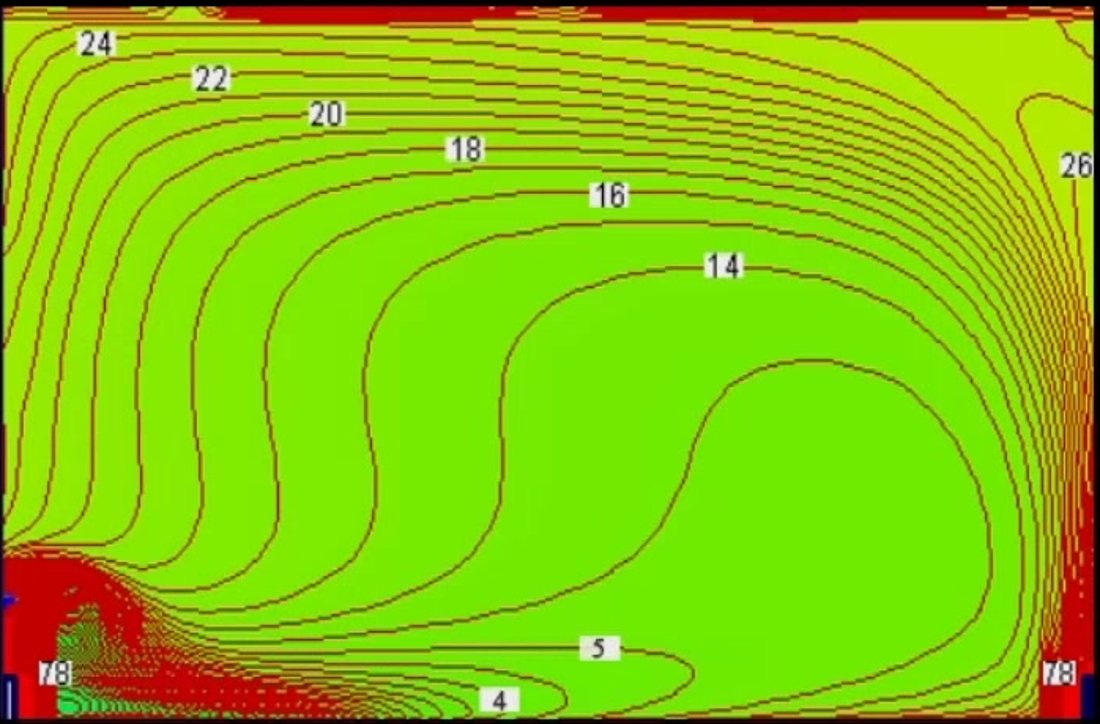
Warm air is lighter than cold air, so without forced circulation it collects under the roof: the gradient in industrial buildings runs at 0.3–1.0 °C per metre of height. CFD modelling of a typical hall shows a picture every energy manager recognises: +24…+26 °C under the roof, and only +4…+5 °C in the working zone near the floor. The heating is running flat out — it is simply heating the roof. The physics is set out in detail in the article on thermal stratification.
Three types of destratifier
| Type | Principle | Strengths | Limitations |
|---|---|---|---|
| Axial destratification fans | a narrow vertical stream from top to bottom | cheap, simple, easy to install | they only mix — no heating, no filtration; many suspension points |
| Large-diameter HVLS fans (4–7 m) | a slow, massive flow over a large area | one machine covers 1,000+ m², and provides cooling airflow in summer | needs clear space with no cranes; provides no heat |
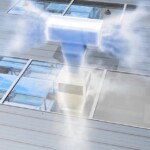
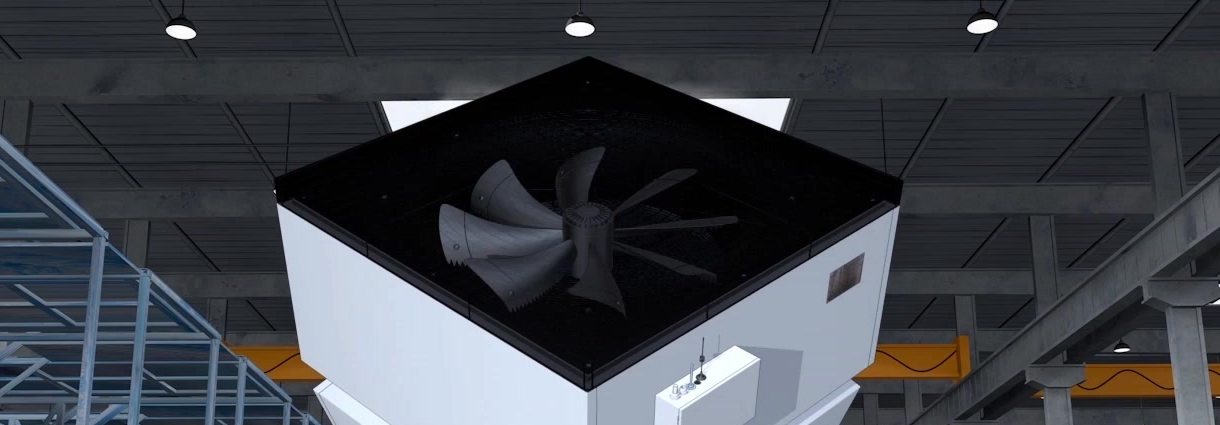
| Heating units with destratification (OXA) | a vortex jet: collect warm air from above, heat it, drive it down | heating and destratification in one device; VAV control; zoning | costs more than a plain fan — a system solution rather than an add-on |
A practical rule for choosing: if the heating system already exists and works, start with simple destratifiers or HVLS fans. If the heating is being designed or replaced, two-in-one units handle both jobs with one piece of equipment and one suspension point per zone.
Field data: the DOE demonstration
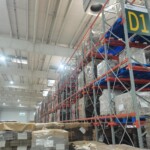
The US Department of Energy ran a season-long comparison at a working warehouse near St. Louis in 2013–14: high-temperature units with destratification against standard gas unit heaters, alternating month by month. The result was a 20 % gas saving, of which only 11 percentage points came from the efficiency difference — the rest came from destratification, a higher supply temperature and lower infiltration. The vertical temperature difference fell by more than 3 °C (U.S. DOE, Field Demonstration of High-Efficiency Gas Heaters, 2014). It remains the best independent confirmation of the effect, and worth knowing before you buy.
How to select a destratifier
- Height. Below 6 m the effect is marginal and a destratifier usually will not pay back. 6–15 m is the core application. Above 15 m you need units with a genuine long throw: the OXA vortex diffuser works up to 30 m.
- Coverage. An axial destratifier handles 100–200 m² per unit; HVLS up to 1,000–1,500 m²; an OXA unit 350–500 m² (throw radius over 10 m).
- Capacity. As a guide: 1.5–2.5 air changes of the room volume per hour, totalled across all the devices in the zone.
- Control. A destratifier with no sensor in the working zone and none under the roof is running blind. The difference between those two readings is the key signal for the controls — the wireless OXA-V/T2 system does this as standard.
Payback: a worked example
Take the 3,000 m² × 10 m warehouse from the calculation article: annual demand on a conventional system is roughly 900 MWh of heat. A conservative 20 % saving from destratification is 180 MWh per season. In money, at a heat cost of about €0.10 per kWh (a gas-fired unit at typical European business gas prices), that is around €18,000 every year. A set of simple destratifiers for a warehouse of that size costs considerably less than that — payback inside a single season; replacing the system with two-in-one units pays back in 1–3 seasons depending on the state of the existing equipment.
When you do not need one
- Ceilings below 5–6 m — the gradient is small and the saving will not cover even a cheap device.
- Radiant (infrared) heating — it warms surfaces rather than air, so air stratification matters less for comfort.
- Permanently open doors or large uncontrolled air movements — deal with the infiltration first (see seven ways to cut costs).
Frequently asked questions
How much does a destratifier save?
20–30 % of heating costs in buildings 8–15 m tall. The DOE field demonstration measured a 20 % total gas saving, most of which came from destratification and reduced infiltration.
How does a destratifier differ from an ordinary ceiling fan?
In purpose and in the airflow it creates: a domestic fan mixes air locally, while a destratifier forms a directed vertical stream capable of driving the hot cushion from under the roof down to the floor without creating a draught where people work.
Do I need a destratifier if I install OXA units?
No — destratification is built in: the axial fan draws warm air down from above and the vortex diffuser returns it as a dense stream. Separate devices are unnecessary.
Does destratification work in summer?
Yes, in reverse: units with a cooling mode (OXA-K/SK/FK) fan cool air out under the ceiling, while HVLS fans create cooling airflow over workstations.