There are two ways to heat a production hall with gas: centrally — a boiler house, a heat main and water-fed units — or decentrally, with gas-fired warm air units burning the fuel inside the hall itself. The second approach delivers a system efficiency of 98.9 % against roughly 85 % for a boiler plus distribution, is running in 2–4 weeks, and needs neither a plant room nor a heat main. Here is when it wins, how much gas it burns and how to work out the number of units.
Two ways to burn the same gas
The physics is identical — a cubic metre of natural gas carries about 9.3 kWh. The difference is how much of that reaches the working zone:
- Boiler house: boiler efficiency 90–94 % → 5–10 % lost in the heat main and pipework → another 15–25 % to stratification when air heaters distribute without destratification. Between 60 and 75 % of the gas energy reaches the working zone.
- Gas-fired unit inside the hall: combustion and heat transfer happen metres from the user. The OXA-GD runs at 98.9 % thermal efficiency (flue gas heat is recovered at the top of the unit) and the vortex diffuser puts that heat straight into the occupied zone. In total, 90–95 % reaches the user.
Boiler house versus gas-fired units
| Criterion | Boiler house + water units | OXA-GD gas-fired units |
|---|---|---|
| System efficiency (gas → working zone) | 60–75 % | 90–95 % |
| Capital cost | boiler, plant room, chimney, heat main, pipework, water treatment | units + DN80 flues + gas connection |
| Lead time | 4–9 months (design, construction, commissioning) | 2–4 weeks of installation |
| Plant room required | yes | no |
| Operator / maintenance | staff or an outsourced boiler house contract | servicing the units once or twice a season |
| Redundancy | a standby boiler (N+1) at additional cost | built into the scheme: losing 1 of 8 units costs 12 % of capacity, not 100 % |
| Risk of the system freezing | present (water in the pipework) | none — there is no water circuit |
| Zoning flexibility | limited by the hydraulics | every unit is its own zone with its own setpoint |
This is not a marketing figure — it is field data. In a US Department of Energy demonstration at a warehouse near St. Louis (2013–14 season), high-efficiency direct-fired gas units used 20 % less gas than standard gas unit heaters in a direct month-to-month comparison. Only 11 percentage points of that came from the efficiency difference (>90 % against 80 %); the rest came from destratification and lower infiltration, with the vertical temperature difference in the building falling by more than 3 °C (source: U.S. DOE, Field Demonstration of High-Efficiency Gas Heaters, 2014).
When a boiler house still makes sense: it already exists and has spare capacity; the site has cheap heat available (cogeneration, waste heat recovery); or the process needs steam or hot water anyway. In those cases, water-fed OXA-D units off the existing source are the rational choice.
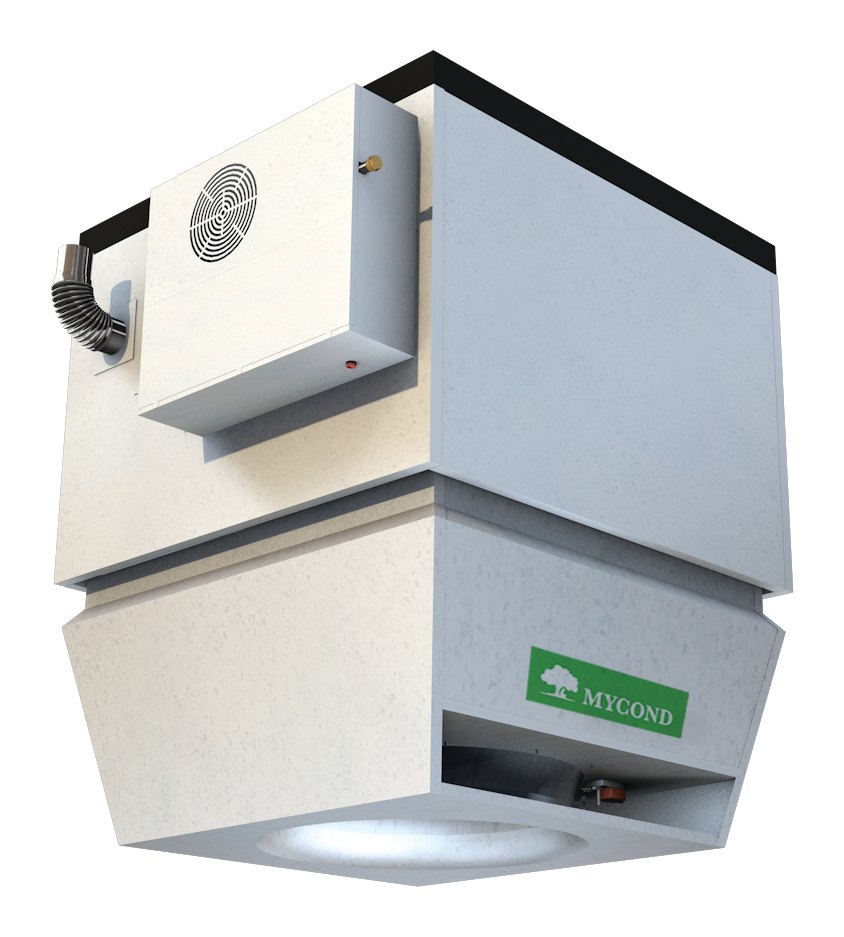
OXA-GD technical data
| Parameter | Value |
|---|---|
| Heating capacity | 0–54.75 kW, modulating burner |
| Thermal efficiency | 98.9 % |
| Gas consumption (max.) | 5.21 m³/h (operating conditions) / 5.64 m³/h (standard) |
| Gas inlet pressure | 5–10 kPa |
| Air flow | up to 10,600 m³/h |
| Recommended mounting height | 4–17 m |
| Flue | DN80 |
| Power supply | 380 V ±5 %, 0–1.85 kW |
| Sound level | <60 dB |
| Weight | 240 kg |
Worked example: a 2,000 m² hall, 8 m high
- Volume: V = 2,000 × 8 = 16,000 m³. Insulated steel frame: q = 0.50 W/(m³·K).
- ΔT = +18 − (−20) = 38 K (Warsaw). Qfabric = 0.50 × 16,000 × 38 = 304 kW.
- Infiltration and doors +15 %: Qdesign = 350 kW.
- Number of units: 350 / 54.75 = 6.4 → 7 OXA-GD units. Coverage check: 2,000 m² / 7 = 286 m² per unit — comfortably within the throw radius.
- Peak gas consumption: 7 × 5.64 = 39.5 m³/h. Seasonal (average load around 40 % of design over 4,400 hours): roughly 65,000–70,000 m³ of gas, or about €60,000–65,000 at the European average non-household price of €0.10 per kWh. A centralised scheme in the same hall would burn 12–15 % more.
The heat loss method with its coefficient tables is set out in a separate article: warehouse heat load calculation. It applies to production halls without modification.
What installation requires
- A medium-pressure gas supply (5–10 kPa) with a metering point — the gas supply design goes through the standard approval route, and no separate plant room is needed.
- A DN80 flue through the roof or wall for each unit.
- A 380 V supply and suspension points on the trusses (each unit weighs 240 kg).
- Burner commissioning by a certified engineer — included in our turnkey installation.
If there is no gas on site
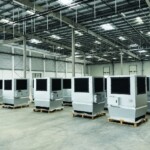
Two workable options. The first is electric OXA-ED units with 30–65 kW heating elements: the simplest installation there is, but every kWh of heat costs a full kWh of electricity. The second, and usually cheaper to run, is DX: OXA-530N/670N units on a VRF system or a condensing unit. In winter they work as a heat pump (up to 75 kW of heat per unit, roughly 3 kWh of heat per kWh of electricity); in summer the same equipment provides up to 68 kW of cooling. It is the fastest scheme to build after the electric one — no hydraulics, no flues, no gas approvals — and the only one that covers both winter and summer.
Frequently asked questions
How much gas does heating a 2,000 m² hall consume?
On the calculation above, 65,000–70,000 m³ per season for an insulated hall 8 m tall held at +18 °C. The state of the insulation and the temperature regime can move that figure by a factor of 1.5–2 in either direction.
Do gas-fired warm air units need approval?
You need a gas supply design and commissioning by a certified engineer, but you do not need a separate plant room, a licensed operator or a boiler house chimney — the process is substantially simpler and faster.
Which is more reliable: one boiler or eight units?
Eight units. Losing one costs 12 % of capacity, which the neighbouring zones absorb. Losing a single boiler stops all the heating. A decentralised scheme is redundant by its own architecture.
And if the site has no gas at all?
DX OXA-530N/670N units on VRF or a condensing unit — a heat pump in winter and air conditioning in summer, installed in a matter of weeks; or electric OXA-ED units, if there is spare electrical capacity.