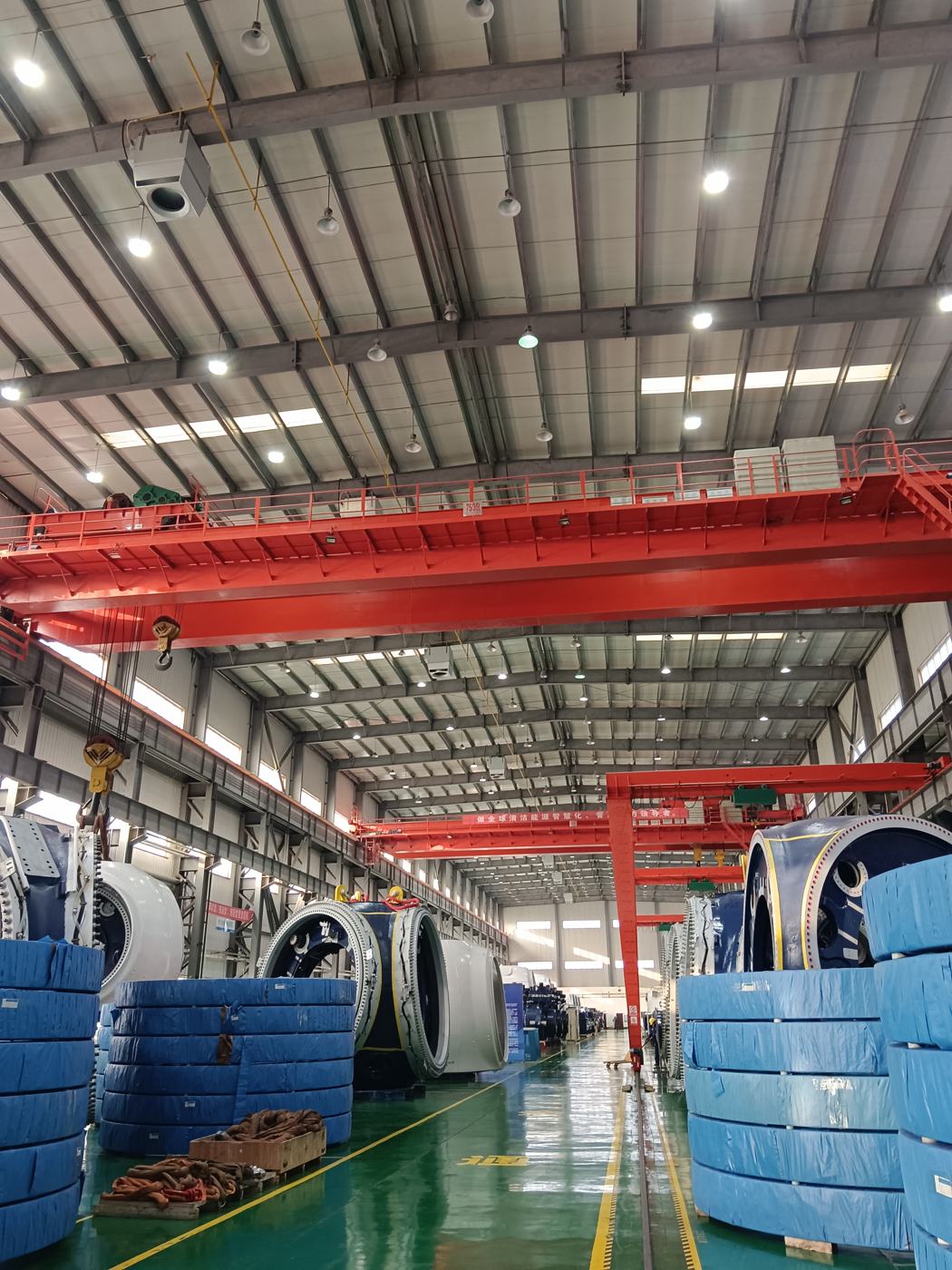
Electric warehouse heating is the right answer in three situations: the site has no gas, you need the fastest and cheapest possible start, or the heating runs in short bursts or as background frost protection. Direct electric heating is about 100 % efficient at the point of use, but every kWh of heat costs exactly one kWh of electricity — which makes it the most expensive source to run. So the decision that matters is not which heating elements to choose, but direct heating or a heat pump: the DX scheme uses a third of the energy. Here are both options with the numbers.
When direct electric heating is the right choice
- No gas, and nowhere to put outdoor units (dense urban sites, leased premises, a ban on facade works).
- Short operating cycles: a loading bay heated for 2–3 hours a day, a repair bay, a small picking store. At low running hours the tariff difference never repays the more expensive equipment.
- Background heating at +5 °C in smaller spaces with occasional peaks.
- Temporary or leased premises: minimal capital cost, and it comes down and moves with you.
- Standby: electric units as emergency backup for the main system.
What a kWh of heat costs from each source
The formula is simple: cost of heat = energy tariff ÷ conversion efficiency. The table uses typical European prices for business consumers; substitute your own and the proportions hold.
| Source | Efficiency | Calculation | Cost of 1 kWh of heat* |
|---|---|---|---|
| Gas unit OXA-GD | 98.9 % efficiency | €0.93/m³ ÷ (9.3 × 0.989) | ≈ €0.10 |
| DX OXA-530N/670N on VRF (heat pump) | COP ≈ 3.0 | €0.20/kWh ÷ 3.0 | ≈ €0.07 |
| Water-fed OXA-D from an existing boiler house | depends on the plant | — | ≈ €0.11–0.13 |
| Electric OXA-ED (direct heating) | COP 1.0 | €0.20/kWh ÷ 1.0 | ≈ €0.20 |
*Based on typical European non-household energy prices — natural gas at roughly €0.09–0.11 per kWh (about €0.85–1.00 per m³ including distribution) and electricity at €0.18–0.22 per kWh depending on voltage level and load profile. Put your own supplier’s tariffs in and the ratios stay the same. The conclusion: run all season and direct electric heating costs about three times what a heat pump costs, while the DX scheme now undercuts gas on the same electricity tariff across much of Europe. That is why we recommend DX for continuous heating without gas, and reserve heating elements for short cycles and standby duty.
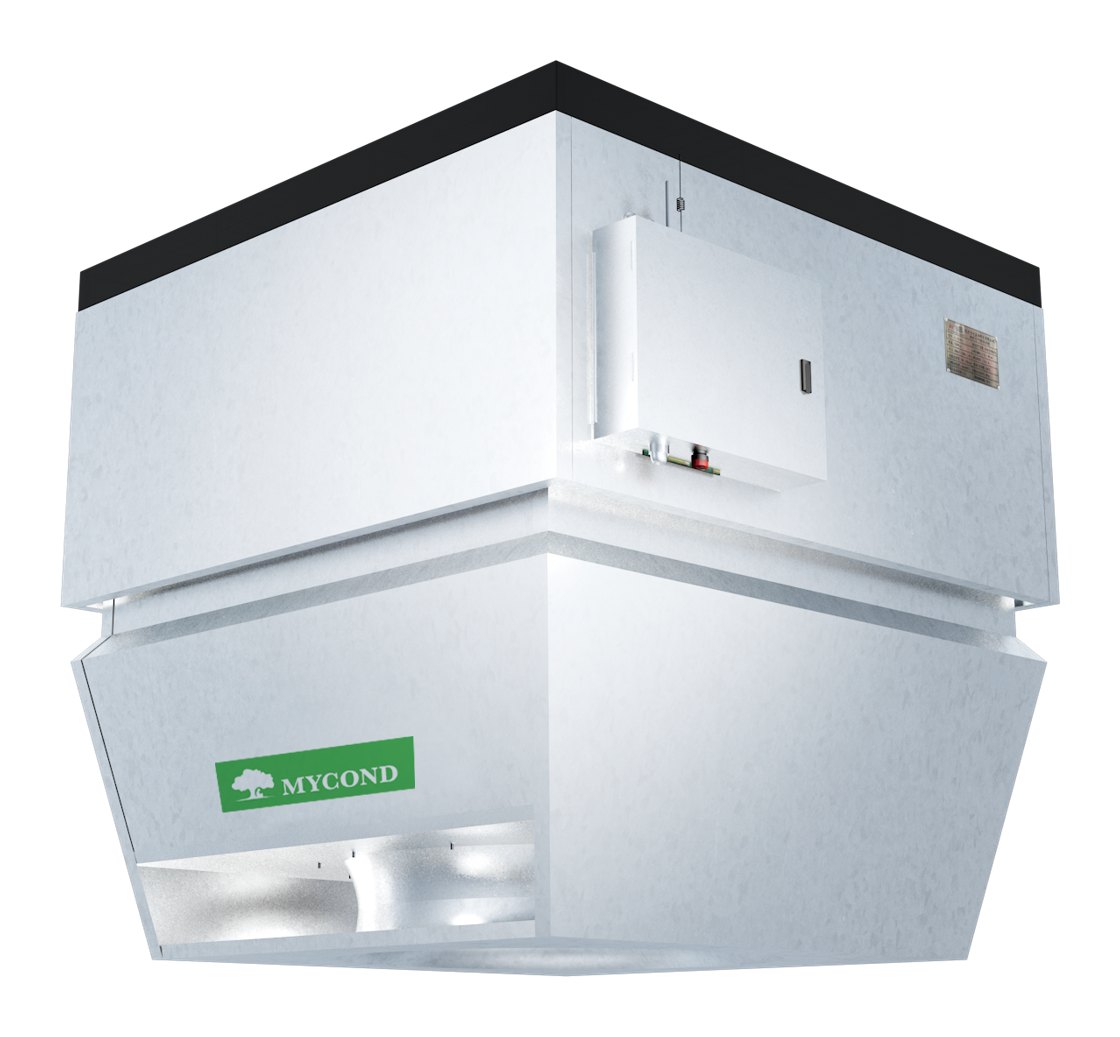
OXA-ED technical data
| Parameter | OXA-ED-I | OXA-ED-II |
|---|---|---|
| Electric heater rating (elements) | 30–45 kW | 35–65 kW |
| Heat output | 25.5–38.25 kW | 29.75–55.25 kW |
| Recirculated air flow | up to 6,700 m³/h | up to 9,700 m³/h |
| Supply air temperature | +22…+39 °C | +21…+40 °C |
| Recommended mounting height | 4–10 m | 4–17 m |
| Control | stepless VAV, synchronised with the heater | as above |
| Power supply | 380 V ±5 % | 380 V ±5 % |
| Sound level | <60 dB | <60 dB |
| Weight | 120 kg | 170 kg |
Worked example: a 1,000 m² warehouse, 6 m high
- Volume 6,000 m³, insulated building: q = 0.45 W/(m³·K), ΔT = 38 K.
- Qfabric = 0.45 × 6,000 × 38 = 103 kW; with infiltration at +15 % → 118 kW.
- Equipment: 2 × OXA-ED-II (2 × 55.25 = 110 kW of heat) covering 500 m² each, or 3 × OXA-ED-I for a more even temperature field.
- Electrical requirement: 2 × 65 kW of elements plus fans ≈ 134 kW of connected load, roughly 205 A at 380 V. Check the spare capacity of your incomer and transformer before ordering — that is the real constraint on electric heating.
- Stepped element control and the VAV fan bring average seasonal consumption down to 35–45 % of connected load.
The DX alternative: the same electricity, three times the heat
DX OXA-530N/670N units connect to a VRF system or a condensing unit and work as a heat pump: one kWh of electricity yields about 3 kWh of heat. For the warehouse above, the 134 kW incomer becomes roughly 45 kW — and the same equipment air conditions the warehouse in summer (up to 68 kW of cooling per unit). Installation stays quick: refrigerant lines instead of hydraulics, no flues and no approval procedures.
| Criterion | OXA-ED (direct heating) | OXA-530N/670N (heat pump) |
|---|---|---|
| Capital cost | minimal | higher (VRF or condensing outdoor units) |
| Electricity consumption | 1 kWh = 1 kWh of heat | 1 kWh = about 3 kWh of heat |
| Connected load needed (1,000 m² warehouse) | ≈ 134 kW | ≈ 45 kW |
| Cooling in summer | no | yes, up to 68 kW per unit |
| Performance in severe frost | unaffected | output falls, so allow margin |
| Best suited to | short cycles, standby, background heating | continuous heating all season, plus summer |
A practical rule: if the heating runs for more than 1,000–1,500 hours a season, cost out the DX scheme — the running difference repays the outdoor units within 2–4 seasons. Below that, take the heating elements and do not overpay for equipment.
Common mistakes
- Not checking the spare capacity of the electrical supply before ordering — the most common reason a project stalls.
- Heating around the clock at one setpoint: with electricity, setback and weekly schedules are critical — they are worth 15–25 % of the bill outright (see seven ways to cut costs).
- One large unit instead of two or three distributed ones: you lose both evenness and redundancy.
- Comparing capital cost alone and ignoring the ten-year cost of ownership — where DX almost always wins under continuous operation.
Frequently asked questions
How much electricity does heating a 1,000 m² warehouse use?
Connected load is around 120–135 kW for direct heating, or about 45 kW for a heat pump. Seasonal consumption with setback comes to roughly 180–220 MWh for heating elements and 60–75 MWh for the DX scheme.
What electrical supply does an OXA-ED need?
380 V, three phase. A single OXA-ED-II with 65 kW of elements draws about 100 A. Always verify the spare capacity of the incomer and the substation.
With no gas, which is better: elements or a DX system?
Above 1,000–1,500 hours a season, DX OXA-530N/670N units (a third of the electricity, plus cooling in summer). For short cycles, standby and background heating, OXA-ED.
Is it safe to hang an electric heater above stored goods?
The OXA-ED uses enclosed elements inside the air stream with overheat protection and heater-to-fan synchronisation; there are no exposed coils. The units also carry a six-axis position sensor that raises an alarm if the mounting shifts.