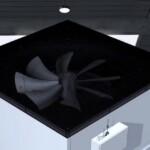
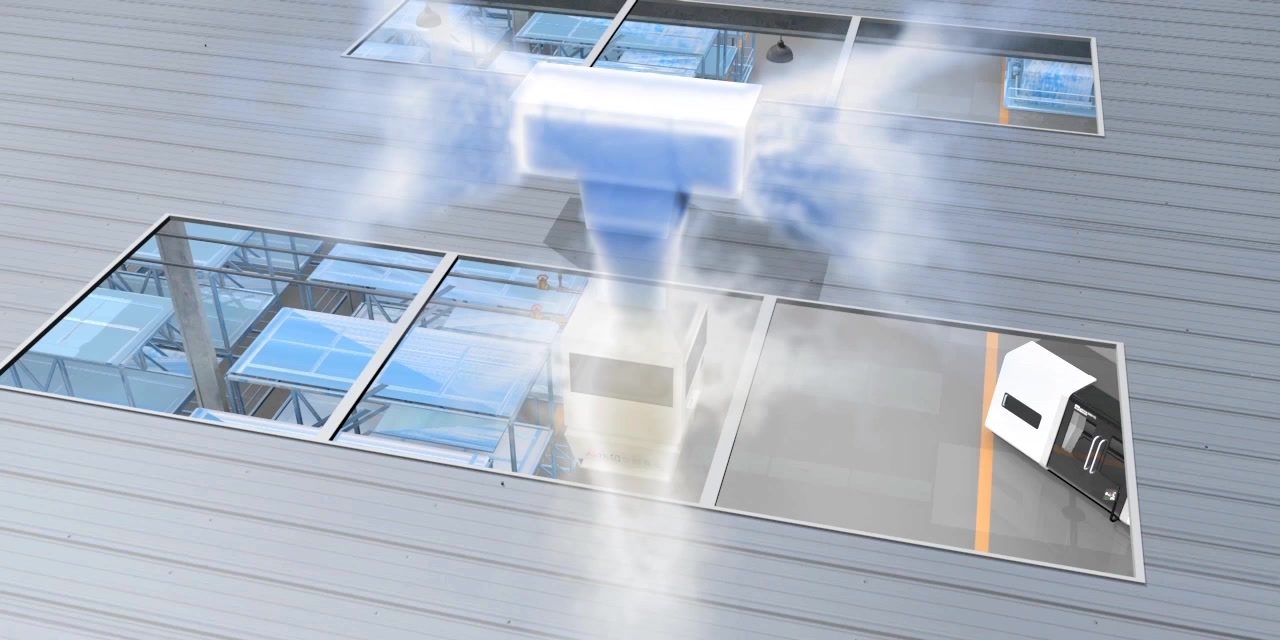
A classic central system means a plant room, kilometres of ductwork, fire dampers, balancing and months of installation. A decentralised scheme puts compact units directly above the working zone — and the ductwork disappears from the project entirely.
Where the saving comes from
- Materials and labour. Ducts, insulation, supports and the work to install them account for up to a third of the HVAC budget on a large building. In a ductless scheme that section of the estimate does not exist.
- Aerodynamic losses. Every metre of duct and every bend is pressure the fan has to overcome. A decentralised unit discharges straight into the space.
- Zoning. Each OXA unit serves its own zone with its own setpoint. Unoccupied zones drop to background heating — something a central system cannot do without expensive VAV boxes.
- Phasing. The building can be commissioned in stages: install part of the units and that zone is already working. Nothing waits on the main distribution being finished.
But what about fresh air?
The objection that “you cannot have ventilation without ducts” is answered by the Fresh Air and AR series: the OXA-FD and OXA-FK carry a modulating outdoor air damper with 100 % supply, mixing and recirculation modes, while the OXA-AR supply and extract unit adds heat recovery — up to 145 kW of heating and 70 kW of cooling in a single casing.
When decentralisation is the right choice
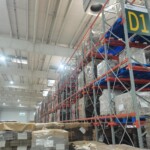
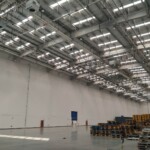
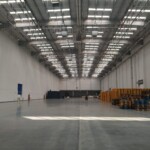
Ceiling heights from 4–6 metres, large floor plates, racked storage, overhead cranes, a need for zoning or for phased handover — these are the classic signs that a ductless scheme will be cheaper and more flexible than a central one. For cleanrooms with strict filtration requirements a central system remains unbeatable, and that is a fair limit to state.